
Ask yourself...
Is the keyword relevant to your website's content? Will searchers find what they are looking for on your site when they search using these keywords? Will they be happy with what they find? Will this traffic result in financial rewards or other organizational goals? If the answer to all of these questions is a clear "Yes!", proceed...
Search for the term/phrase in the major engines
Understanding which websites already rank for your keyword gives you valuable insight into the competition, and also how hard it will be to rank for the given term. Are there search advertisements running along the top and right-hand side of the organic results? Typically, many search ads means a high value keyword, and multiple search ads above the organic results often means a highly lucrative and directly conversion-prone keyword.
Buy a sample campaign for the keyword at Google AdWords and/or Bing Adcenter
If your website doesn't rank for the keyword, you can nonetheless buy "test" traffic to see how well it converts. InGoogle Adwords, choose "exact match" and point the traffic to the relevant page on your website. Track impressions and conversion rate over the course of at least 2-300 clicks.
Using the data you’ve collected, determine the exact value of each keyword.
For example, if your search ad generated 5,000 impressions, of which 100 visitors have come to your site and 3 have converted for total profit (not revenue!) of $300, then a single visitor for that keyword is worth $3 to your business. Those 5,000 impressions in 24 hours could generate a click-through rate of between 18-36% with a #1 ranking (see the Slingshot SEO study for more on potential click-through rates), which would mean 900-1800 visits per day, at $3 each, or between 1-2 million dollars per year. No wonder businesses love search marketing!
|
Going back to our online shoe store example, it would be great to rank #1 for the keyword "shoes" - or would it?
It's wonderful to deal with keywords that have 5,000 searches a day, or even 500 searches a day, but in reality, these "popular" search terms actually make up less than 30% of the searches performed on the web. The remaining 70% lie in what's called the "long tail" of search. The long tail contains hundreds of millions of unique searches that might be conducted a few times in any given day, but, when taken together, they comprise the majority of the world's demand for information through search engines.
Another lesson search marketers have learned is that long tail keywords often convert better, because they catch people later in the buying/conversion cycle. A person searching for "shoes" is probably browsing, and not ready to buy. On the other hand, someone searching for "best price on Air Jordan size 12" practically has their wallet out!
Understanding the search demand curve is critical. To the right we've included a sample keyword demand curve, illustrating the small number of queries sending larger amounts of traffic alongside the volume of less-searched terms and phrases that bring the bulk of our search referrals.


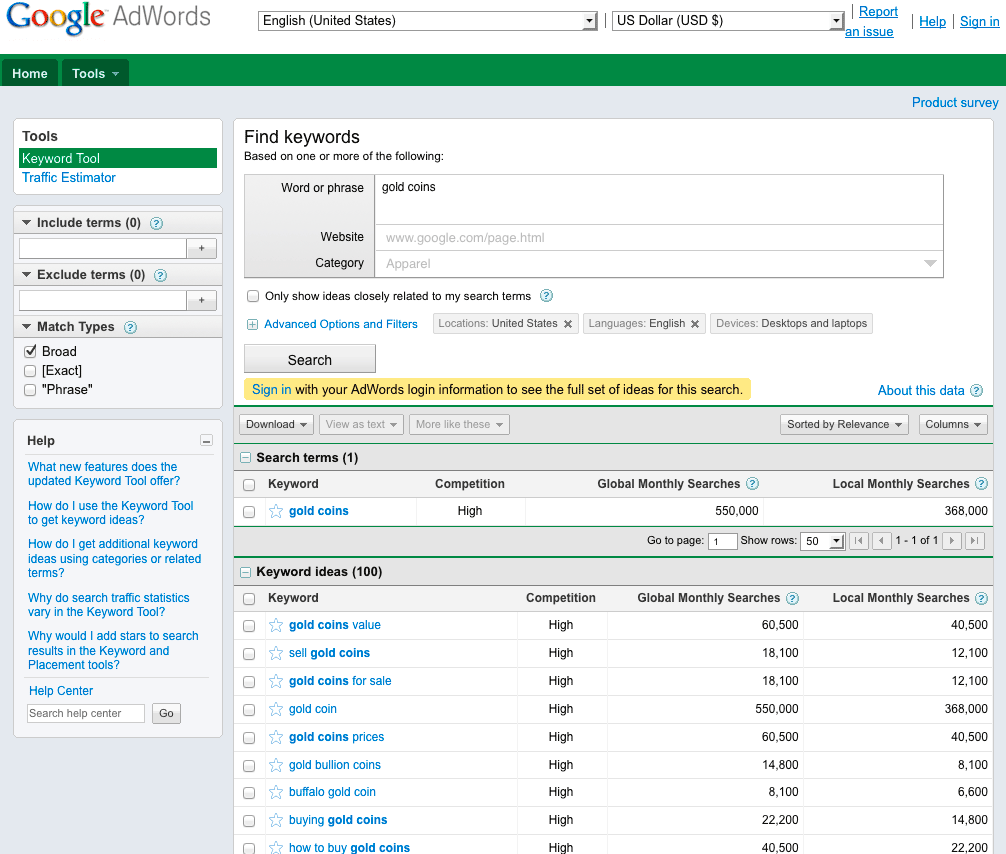
Google’s AdWords Keyword Tool provides suggested keyword and volume data.
Resources
Where do we get all of this knowledge about keyword demand and keyword referrals? From research sources like these listed here:
- Google Adwords’ Keyword Tool
- Google Insights for Search
- Google Trends Keyword Demand Prediction
- Microsoft Advertising Intelligence
- Wordtracker’s Free Basic Keyword Demand
Google's AdWords Keyword tool is a common starting point for SEO keyword research. It not only suggests keywords and provides estimated search volume, but also predicts the cost of running paid campaigns for these terms. To determine volume for a particular keyword, be sure to set the Match Type to [Exact] and look under Local Monthly Searches. Remember that these represent total searches. Depending on your ranking and click-through rate, the actual number of visitors you achieve for these keywords will usually be much lower.
Other sources for keyword information exist, as do tools with more advanced data. The Moz blog category on Keyword Research is an excellent place to start.
What are my chances of success?
In order to know which keywords to target, it's essential to not only understand the demand for a given term or phrase, but also thework required to achieve those rankings. If big brands take the top 10 results and you're just starting out on the web, the uphill battle for rankings can take years of effort. This is why it's essential to understand keyword difficulty.Different tools around the web help provide this information. One of these, Moz’s own Keyword Analysis Tool does a good job collecting all of these metrics and providing a comparative score for any given search term or phrase.


0 comments:
Post a Comment